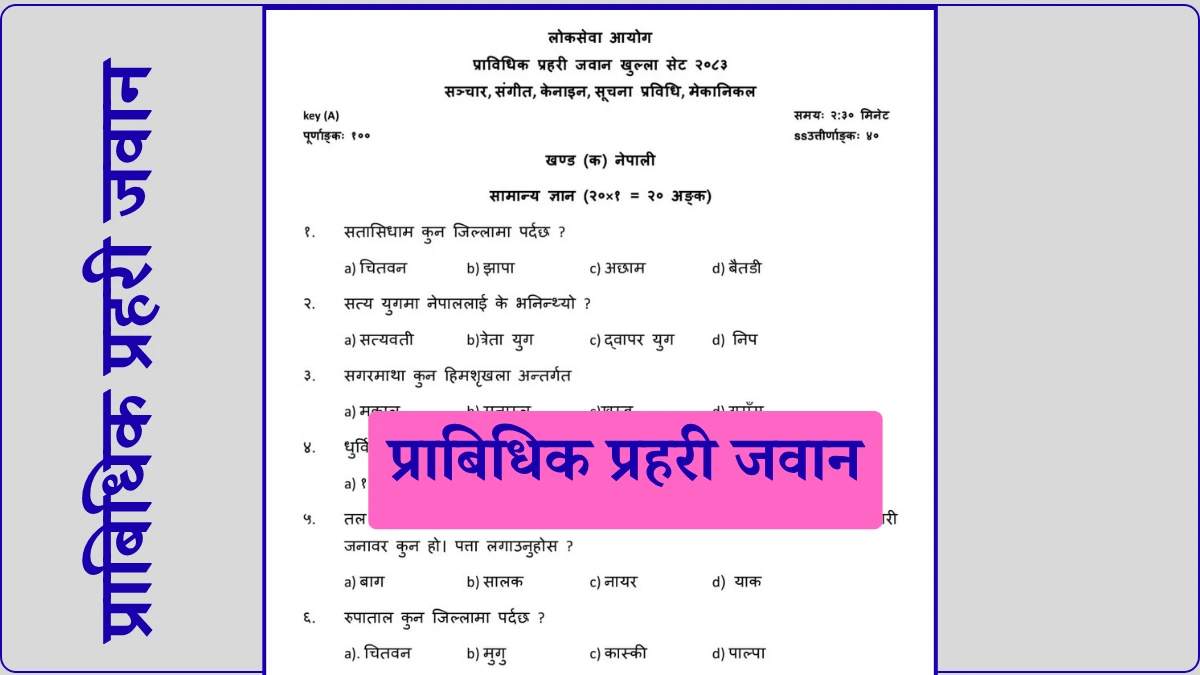
The Prabidhik Prahari Jawan Model Question is a useful preparation resource for candidates who are getting ready for the technical police constable examination in Nepal. Practicing model questions before the examination can help candidates become familiar with different question types, improve time management, and identify subjects that require additional preparation.
For candidates preparing for Prabidhik Prahari Jawan, regular practice is especially useful because technical positions may require knowledge related to the specific technical group as well as subjects included in the official examination syllabus.
A model question should be treated as a practice resource rather than a prediction of the actual examination. Candidates should always give priority to the latest official vacancy notice, syllabus, examination schedule, and instructions issued by the relevant authority.
What Is Prabidhik Prahari Jawan Model Question?
A Prabidhik Prahari Jawan Model Question is a practice question set designed to help candidates prepare for the examination process. It can be used for self-study, revision, mock tests, and preparation before the written examination.
Depending on the technical position and current syllabus, candidates may need to prepare different subjects and areas of knowledge. Therefore, it is important to select model questions that match the position and syllabus for which you are applying.
Model questions are most effective when candidates solve them under a fixed time limit and review their answers afterward.
Read Also: Prabidhik Prahari Jawan Model Question – Practice Set and Exam Preparation
Why Practice Prabidhik Prahari Jawan Model Questions?
Competitive examinations require both knowledge and the ability to answer questions accurately within a limited period. Regular practice can help candidates develop these skills.
Some important benefits include:
- Understanding common question formats
- Improving answering speed
- Practicing time management
- Identifying weak topics
- Revising previously studied material
- Improving confidence before the examination
- Becoming familiar with mock-test conditions
A candidate who regularly analyzes mistakes can gradually improve performance rather than simply repeating the same study routine.
Prabidhik Prahari Jawan Exam Preparation
Good preparation begins with understanding the official requirements. Before selecting study materials, candidates should check the latest recruitment notice and syllabus for the relevant technical position.
The syllabus should be used as the main guide for preparation. Divide the subjects into smaller sections and create a practical study schedule.
For example, candidates can dedicate separate study sessions to technical subjects, general topics, reasoning, mathematics, language, or other areas included in their particular syllabus.
The exact subjects may vary according to the position and recruitment notice, so candidates should avoid relying on outdated preparation guides.
Prabidhik Prahari Jawan Practice Set
A Prabidhik Prahari Jawan Practice Set can be used after studying individual topics. Instead of immediately attempting a full-length test, candidates can first practice questions by subject.
Subject-wise practice helps identify specific areas where mistakes occur frequently. Once the basic concepts are stronger, candidates can move to mixed practice sets.
A good practice routine can include:
- Study a particular topic.
- Solve related practice questions.
- Check the answers.
- Review incorrect responses.
- Revise the relevant topic.
- Take another practice set.
This cycle can make preparation more organized and measurable.
Prabidhik Prahari Jawan Model Question PDF
Candidates may prefer a Prabidhik Prahari Jawan Model Question PDF because PDF materials are convenient for offline study and revision. A digital question paper can also be printed when a candidate prefers solving questions on paper.
However, candidates should check whether a PDF is based on the current syllabus. Old materials may contain outdated information or a previous examination structure.
Before relying on any model question PDF, compare its content with the latest official syllabus and recruitment information.
How to Solve Model Questions Effectively
The way you practice is just as important as the number of questions you solve.
Set a Time Limit
Try to solve the practice paper within a realistic time limit. Avoid using study materials while taking the test.
Attempt Easy Questions First
If the examination format allows it, answer questions you know first. Difficult questions can be reviewed later. This approach can help prevent spending too much time on a single problem.
Check Every Mistake
Do not stop after calculating your score. Review incorrect answers and identify the reason for each mistake.
Keep a Revision List
Maintain a list of difficult topics, formulas, facts, or concepts that need repeated revision.
Track Your Progress
Record your scores across different practice tests. Increasing accuracy and reducing the time needed to solve questions can be useful indicators of progress.
Prabidhik Prahari Jawan Old Question Paper
Old question papers can provide valuable practice and help candidates understand the style of previous examinations. They may also help identify the types of questions candidates have encountered in earlier recruitment processes.
However, old questions should not be considered a guarantee for future examinations. The syllabus, examination structure, and subject requirements can change.
Use old question papers together with current study materials rather than depending on them alone.
Common Preparation Mistakes
Many candidates spend considerable time collecting study materials but do not practice enough questions. Others focus entirely on memorizing answers without understanding the underlying topic.
Common mistakes include:
- Ignoring the latest official syllabus
- Depending only on old questions
- Not practicing under time limits
- Failing to review incorrect answers
- Using outdated study materials
- Spending too much time on one difficult question
- Studying irregularly
A consistent study schedule and regular practice are generally more effective than last-minute preparation.
Tips to Improve Your Score
Start with the basics and gradually move toward more difficult questions. Do not rush through practice sets simply to complete a large number of questions.
Review difficult topics regularly and take full-length mock tests as the examination approaches. Try to maintain a balance between learning new material and revising previously studied topics.
Candidates should also follow official announcements for important updates. Recruitment dates, eligibility requirements, syllabus details, and examination procedures should be confirmed through authoritative sources.
Frequently Asked Questions
What is a Prabidhik Prahari Jawan Model Question?
It is a practice question set designed to help candidates prepare for the Prabidhik Prahari Jawan examination. It can be used for revision, self-assessment, and mock-test practice.
Is the model question the same as the actual exam paper?
No. A model question is a practice resource and cannot guarantee the questions that will appear in the actual examination.
Can I use old question papers for preparation?
Yes. Old question papers can be useful for understanding previous question styles and practicing under time limits. However, candidates should also study according to the current syllabus.
Is a Prabidhik Prahari Jawan Model Question PDF useful?
Yes. A relevant PDF can be convenient for offline practice and revision, provided its content matches the current examination requirements.
How can I prepare better for the examination?
Follow the current official syllabus, study consistently, practice model questions, review mistakes, take timed mock tests, and revise important topics regularly.
Conclusion
The Prabidhik Prahari Jawan Model Question can be an important part of a structured examination preparation strategy. Model questions, practice sets, old question papers, and suitable PDF resources can help candidates improve their understanding, speed, accuracy, and confidence.
